
A driver may be liable for a wet leaves car accident in New Jersey when that driver fails to adjust speed, following distance, or vehicle control to slippery road conditions. Depending on how the hazard arose, a property owner, landscaping contractor, or public entity may also share responsibility. You must establish negligent conduct, causation, and legally recoverable losses. New Jersey insurance rules and comparative fault laws may affect the compensation available to you.
If you were injured in a collision involving wet leaves in Jersey City, Montclair, or another New Jersey community, documenting the road conditions and identifying every potentially responsible party can help protect your claim.
Why Wet Leaves Create Slippery Road Conditions
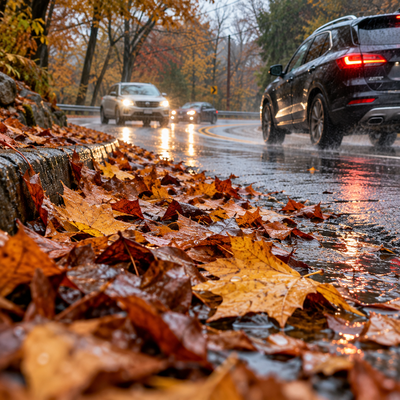
Rain-soaked leaves can form a slick layer between tires and pavement, reducing traction when a driver brakes, accelerates, or turns. A layer of leaves can also hide potholes, roadway markings, and standing water. Tree-lined residential streets, intersections, and curved roads may present particular challenges after autumn rainfall.
Conditions that may contribute to a wet-leaf crash include:
- Accumulated leaves covering a travel lane or intersection.
- Recent rainfall and reduced visibility.
- A sharp curve or abrupt braking on a slippery surface.
- Standing water near a blocked drainage inlet.
- Speed or following distance that does not account for existing conditions.
Key point: Wet leaves can explain how a crash occurred, but they do not automatically excuse careless driving.
Who Is Liable for a Wet Leaves Car Accident in New Jersey?
The driver whose lack of reasonable care caused the collision is often the primary responsible party. Under N.J.S.A. 39:4-97, careless driving involves operating a vehicle without due caution and circumspection in a manner that endangers or is likely to endanger a person or property. Civil negligence still requires consideration of the evidence and the applicable duty of care.
Imagine a driver approaching a leaf-covered curve in Montclair after rainfall. If that driver travels too fast for the visible conditions and strikes your vehicle, the wet leaves may be a contributing factor while the driver may remain legally responsible.
Evidence relevant to driver fault can include:
- Speed, braking, and steering before the collision.
- Distraction or failure to watch the roadway.
- Tire condition and mechanical problems.
- Weather, lighting, and visibility.
- Following distance and available time to respond.
The legal question is whether the conduct fell below reasonable care under the circumstances and caused the claimed harm.
Can a Municipality or the State Be Liable for Leaves on a Road?
A New Jersey public entity may be liable for a dangerous condition of public property only when the requirements of the Tort Claims Act are met. Under N.J.S.A. 59:4-2, the analysis includes whether the property was dangerous, whether that condition proximately caused the injury and presented a reasonably foreseeable risk, and whether a public employee created the condition or the entity had the required notice. The entity’s conduct must also meet the statutory palpable-unreasonableness standard.
For example, repeated documented complaints about an unusually hazardous buildup may matter to a notice analysis. Whether those records support liability depends on the specific roadway, the time the condition existed, maintenance responsibilities, and statutory immunities.
A city, county, or state agency is not liable merely because leaves naturally fell onto a public road. Claims against public entities also have special notice and filing requirements.
Could a Property Owner or Landscaping Contractor Share Fault?
A private party may face liability when its negligent conduct creates or worsens a road hazard. For example, a landscaping contractor that blows large amounts of leaves into an active roadway could potentially contribute to a collision.
A claim would require evidence of a legal duty, breach of that duty, causation, and damages. Owning a property with nearby trees does not by itself make the owner liable for naturally falling leaves.
How Does Comparative Fault Affect Compensation?
New Jersey applies modified comparative negligence under N.J.S.A. 2A:15-5.1. An injured person generally can recover if that person’s negligence is not greater than the negligence of the party or parties against whom recovery is sought, subject to the rules governing allocation among defendants. The recovery is reduced by the injured person’s percentage of fault.
Suppose you have $50,000 in recoverable damages and are assigned 30% fault because of your following distance. A 30% reduction would leave $35,000, assuming the remaining legal requirements are met. Your ability to collect that amount may depend on the defendants, fault allocation, coverage, and other rules.
When several people contributed to a crash, photographs, witness accounts, and reconstruction evidence may be needed to determine each party’s role.
What Insurance May Cover After a Wet-Leaf Collision?
New Jersey Personal Injury Protection (PIP) benefits generally address eligible accident-related medical expenses regardless of fault, within applicable policy terms and statutory limitations. PIP does not by itself determine who must pay for vehicle repairs or other losses.
Depending on the policy, injuries, and available defendants, a claim may involve:
- Eligible medical costs and treatment expenses, subject to PIP and other applicable rules.
- Lost income and qualifying future economic losses.
- Vehicle repair or total-loss expenses.
- Other provable accident-related economic losses.
- Pain and suffering when the applicable lawsuit threshold and other requirements permit recovery.
New Jersey offers a limitation-on-lawsuit option that may restrict noneconomic damages unless a qualifying injury or exception applies. Avoid assuming that every medical bill or wage loss can be recovered again from an at-fault driver.
Related guide: Car accident compensation (https://www.freemanhugheslaw.com/car-accident-compensation/)
What Evidence Can Help Prove Wet Leaves Accident Liability?
Take photographs of the leaf accumulation, road surface, surrounding trees, drainage inlets, signs, vehicle positions, and damage when it is safe. Weather records may help establish the timing of rainfall. Witnesses, traffic cameras, dashcam footage, and vehicle data may also clarify events.
If road maintenance is in question, records of prior reports, inspections, and cleanup practices may be relevant. Police reports provide useful observations but do not independently decide civil liability.
Related guide: The importance of police reports in New Jersey car accident cases (https://www.freemanhugheslaw.com/the-importance-of-police-reports-in-new-jersey-car-accident-cases/)
What Should You Do After a Wet Leaves Car Accident?
Your immediate priorities are safety, medical attention, and accurate documentation. If you can do so safely, take the following steps:
- Check for injuries and call emergency services when needed.
- Follow applicable reporting requirements and the instructions of responding officers.
- Photograph the wet leaves, roadway, vehicles, and visible injuries.
- Exchange contact and insurance information with the other drivers.
- Ask witnesses for their contact details.
- Get medical care for injuries or symptoms that emerge after the crash.
- Notify your insurer and preserve relevant records and recordings.
- Discuss potentially responsible parties and filing deadlines with an attorney.
When speaking with an insurer or investigator, describe what you observed without guessing about the cause or accepting blame before the facts are established.
Related guide: What steps to take after a car accident (https://www.freemanhugheslaw.com/what-steps-to-take-after-a-car-accident/)
How Long Do You Have to Bring a New Jersey Claim?
Under N.J.S.A. 2A:14-2, many New Jersey personal injury actions involving adults have a two-year limitations period, usually measured from accrual. Exceptions and different deadlines may apply, so the accident date alone does not resolve every deadline question.
A claim against a public entity is particularly time-sensitive. N.J.S.A. 59:8-8 generally requires service of a notice of claim within 90 days after accrual. Late-notice relief is limited and subject to additional statutory requirements. Because government claims differ from ordinary auto claims, prompt legal review is especially valuable.
Related guide: Understanding the New Jersey statute of limitations for car accident claims (https://www.freemanhugheslaw.com/understanding-the-new-jersey-statute-of-limitations-for-car-accident-claims/)
Frequently Asked Questions About Wet-Leaf Crashes
Can a driver blame wet leaves for losing control?
Wet leaves may explain the loss of traction, but a driver still must use reasonable care. The available evidence determines whether that driver failed to adjust to foreseeable road conditions.
Can you recover compensation if your vehicle slid on wet leaves?
Possibly. Recovery depends on whether another party was legally responsible, your own share of fault, your insurance coverage, and the nature of your losses.
Does a municipality have to clear every fallen leaf immediately?
No. The presence of leaves alone does not establish public-entity liability. New Jersey law requires proof of the statutory elements for a dangerous condition of public property.
What if you hit a tree after sliding on wet leaves?
If no third party was negligent, any available payment may depend largely on your own auto policy. A claim against another party requires proof that its conduct or a legally actionable property condition caused the crash.
Speak With a New Jersey Car Accident Attorney
If a crash involving wet leaves left you injured, Freeman Law Center, LLC can review the driver conduct, available insurance, roadway evidence, and possible claims against other responsible parties. The firm serves clients in Jersey City, Montclair, and nearby New Jersey communities from its offices in Jersey City and Montclair.
contact Freeman Law Center, LLC online to request an initial consultation and discuss the circumstances of your collision.
This article provides general information and is not legal advice. A lawyer can assess the facts and deadlines that apply to your situation.